
Setting
Intro Physics
Undergraduate course at a major research university. AI hints embedded directly in homework via Kudu.
A peer-reviewed study from researchers at UCLA and UC San Diego examined two interventions deployed in Kudu: scaled extra credit on supplemental math, and AI-generated hints embedded in physics homework. Both interventions correlated with higher exam scores and reduced disparities in completion rates among students from groups historically underserved in introductory STEM.
88%
of students used the AI hints on at least one homework question, when hints were available.
p = 0.004
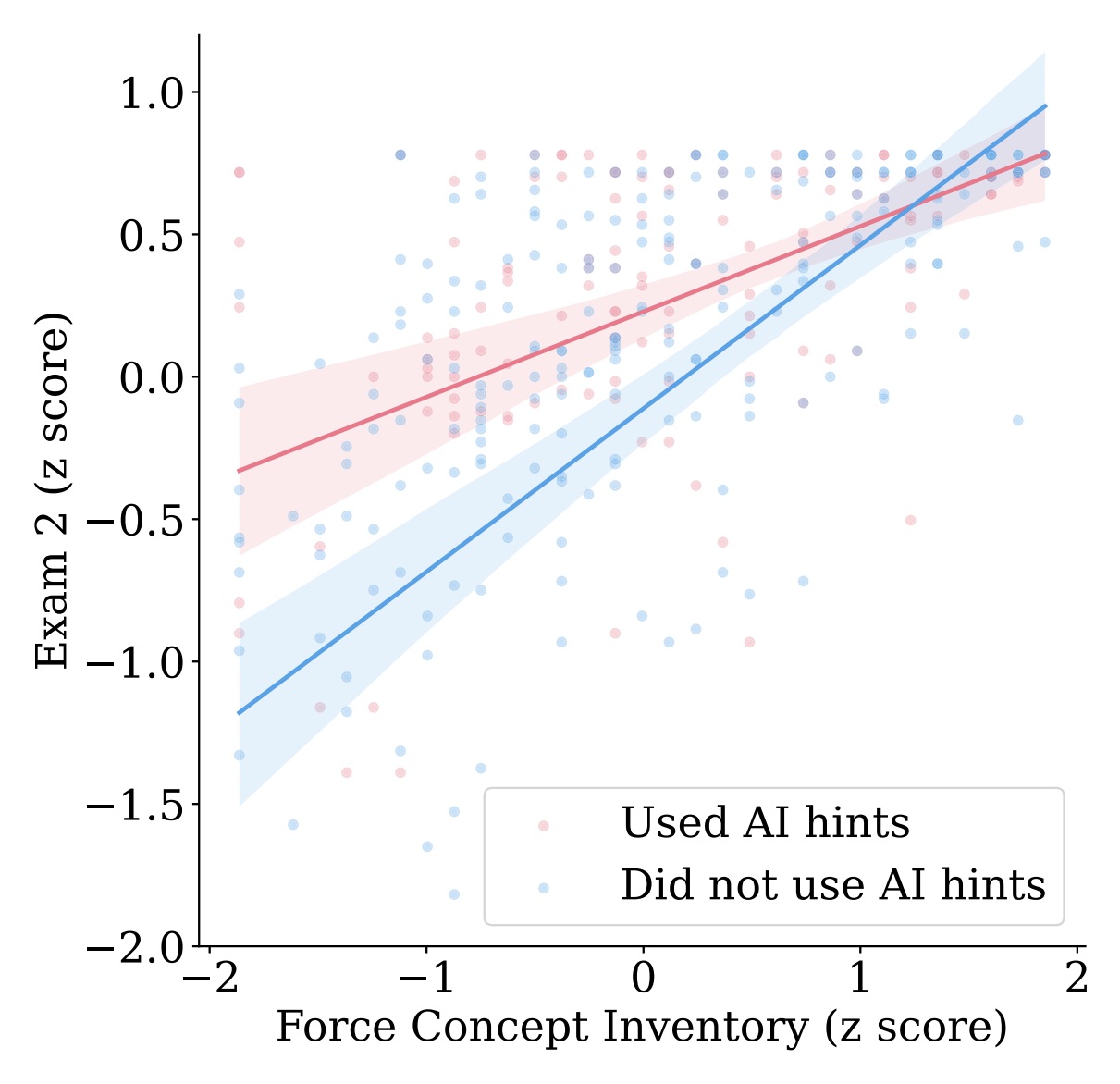
AI hint use was significantly associated with higher exam 2 scores.
188 and 194
students, in the study’s two sections of calculus-based mechanics.
THE AIMS STUDY AT A GLANCE
Researchers at UCLA's Center for Education Innovation and Learning in the Sciences (CEILS), partnered with UC San Diego, set out to test whether two specific interventions — scaled extra credit and AI-generated hints — could close the gap between students who arrive in introductory physics with strong math preparation and those who don't.
Setting
Undergraduate course at a major research university. AI hints embedded directly in homework via Kudu.
Question
Specifically, do they help most the students least likely to ask a TA, peer, or instructor for support?
Design
Scaled extra credit on supplemental math, plus AI-generated hints in physics homework. Both optional, both available to every student equally.
Results
Higher exam performance for students using the interventions. Fewer completion gaps among students historically underserved in STEM.
THE HEADLINE FINDING
Controlling for incoming physics understanding (measured by Force Concept Inventory score) and other variables, students who completed the supplemental math assignment scored higher on subsequent exams. The effect was largest on the third exam — the exam most aligned with the supplemental material.
Crucially, the effect was strongest for students who entered the course with weaker math preparation. Black, Hispanic and Latine, Native American, and lower-income students disproportionately benefit, because they're statistically less likely to have had access to advanced math courses in high school.
"Using AI tools can remove social barriers that prevent students from asking instructors, teaching assistants, and/or peers for help."
WHAT WAS TESTED
Both interventions are grounded in Situated Expectancy-Value Theory of Achievement Motivation — students engage more in tasks they expect to succeed in and perceive as valuable.
Intervention 01
Optional supplemental math assignments were offered to all students. Extra credit was scaled so that students with lower exam scores could earn more from completing the assignments — making the effort proportionally more valuable to the students who most needed the boost.
This addresses the "gifts for the gifted" problem common to traditional extra credit, where high-performing students receive marginal benefit and lower-performing students receive a structural reward for catching up.
54% vs. 19%
Completion rates among students below the class FCI mean — with scaled incentives vs. without.
Intervention 02
Optional AI-generated hints were embedded directly in physics homework problems on Kudu. Hints were grounded in the chapter content the student was studying — so a student stuck on a problem could ask for guidance without leaving the course context, and without the social cost of asking a TA or peer.
The hints are explicitly designed not to provide solutions. They guide students through the reasoning rather than handing them an answer.
88%
Of students used AI-generated hints on at least one homework problem matched to an exam question.
More on AI hint usage
88%
Used hints on at least one matched problem
57%
Used hints on at least five problems
~20%
Average share of questions where hints were used
IN THEIR WORDS
By implementing scalable and low-cost interventions, we can create more equitable learning environments. Using AI tools can remove social barriers that prevent students from asking instructors, teaching assistants, and/or peers for help.
Our findings demonstrate that thoughtful integration of technology and targeted incentives can make a meaningful difference in student academic performance. These strategies are effective and feasible for widespread adoption in a wide range of undergraduate courses that include mathematical topics.
WHERE THE RESEARCH GOES NEXT
Following the publication, UCLA's Teaching and Learning Center funded an expansion of the AIMS program to additional Physical Sciences and Life Sciences courses over two academic years. Faculty in chemistry and life sciences are now adapting the supplemental math materials to their own course contexts and embedding AI-generated hints in their homework on Kudu.
The goal: increase use of these interventions specifically among students who could most benefit, and reduce DFW (D, F, Withdraw) rates and grade disparities across the science core.
This is the part that matters for institutions evaluating Kudu. The research isn't a one-off; it's the foundation of an ongoing program.
| Course | Department |
|---|---|
| Physics 1 series | Physics & Astronomy |
| Chemistry 14 series | Chemistry & Biochemistry |
| Chemistry 20 series | Chemistry & Biochemistry |
| LS 30A | Life Sciences Core |
Expansion funded by UCLA's Teaching and Learning Center. Per the CEILS program description, instructors using the tools in subsequent iterations face minimal additional implementation labor.
KUDU'S ROLE, IN PLAIN LANGUAGE
Kudu provided the course platform on which AIMS was deployed. The AI-generated hints were delivered through Kudu. The supplemental math assignments were administered via Kudu. Student usage data came from Kudu.
The research itself is independent: designed, conducted, analyzed, and published by researchers at UCLA's Center for Education Innovation and Learning in the Sciences and UC San Diego. Funding came from UCLA's Teaching and Learning Center.
What that distinction matters for: when you read claims about Kudu's AI improving learning outcomes, those claims rest on peer-reviewed work that wasn't led, sponsored, or paid for by us. We helped build the tools, but we didn't grade the homework.
Problem 4.3
A block of mass 5 kg slides down a frictionless incline of angle 30°. Find the acceleration.
KAI Hint
Let's break this down step by step.
READ THE WORK
PRIMARY CITATION
Lu, Y., Supriya, K., Shaked, S., Simmons, E. H., & Kusenko, A. (2025). Incentivizing supplemental math assignments and using AI-generated hints is associated with improved exam performance. Physical Review Physics Education Research.DOI: 10.1103/v93w-ytyc ↗Publication
Program
Press
WHERE TO NEXT
For institutions
A 30-minute mapping call with your teaching & learning office: how the AIMS interventions could apply to the courses you already run, and what the program would cost.
For faculty
AI-generated hints are built into every Kudu course. Start a free Kudu course in your subject in minutes and see how they work in your homework.
For press & researchers
This page is the canonical source for the AIMS study and Kudu's role in it. Stable URL. Updates tracked. Reach out if you'd like to discuss replication or expansion studies.